
Getting 25W into a wireless charger is not the hard part. The hard part is keeping 25W without the phone and the pad burning your hand. The Wireless Power Consortium's Qi2.2 standard, formally published in December 2024, draws the line in plain text: at 25W output, surface temperature at any point on the device must stay below 40°C. It is a pass-or-fail rule in the certification test, not a guideline. That single line retires the old 'peak 30W, throttles after 10 minutes' trick.
From Wattage Wars to Thermal Control: The Hardware Reset
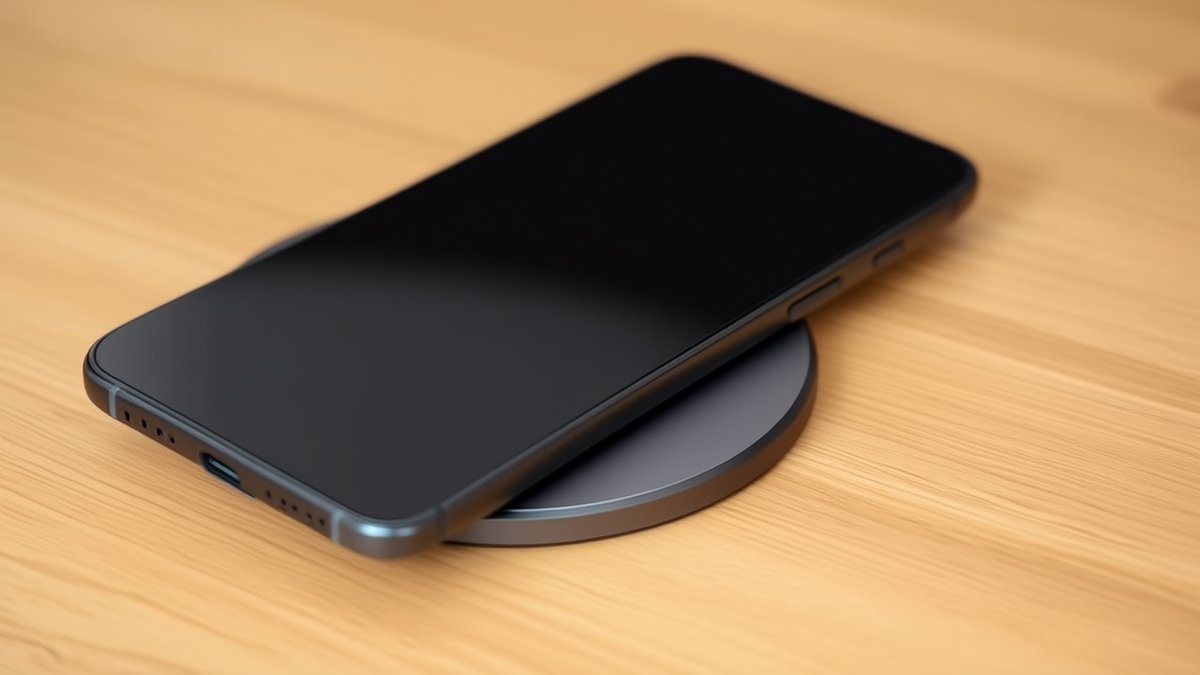
Stable 25W output needs hardware and firmware moving together. On the hardware side, multi-layer coil assemblies with dedicated heat-sink plates have become standard. Housing materials shift to thermally conductive aluminum alloys or engineering plastics. Ferrite core geometry is redesigned to spread electromagnetic flux more evenly. On the firmware side, every Qi2.2 charger carries embedded NTC thermistors that monitor surface temperature in real time. When the reading approaches 40°C, power output throttles dynamically, and ramps back up once the system cools. Teardowns from Elecdov and similar vendors consistently describe both layers as required, not optional.
GaN is the other critical piece. Gallium nitride transistors replace traditional silicon MOSFETs, switch faster, lose less energy as heat, and stay significantly cooler at equivalent power. The practical effect is that 25W Qi2.2 chargers hold full output across an entire charge cycle rather than dropping to 7.5W after the first 15 minutes, as many early products did. Third-party lab data puts the real-world gap at 72% in 30 minutes for 25W versus 22% for legacy 7.5W, a 3x improvement that comes straight from the material layer.
Foreign Object Detection: A 25W Problem That Forbade Shortcuts
FOD used to be a nice-to-have at 5W. At 25W, it is mandatory. Higher power means stronger induced electromagnetic fields, which means metal objects on the charging surface heat up much faster, a coin can leave a visible mark within two minutes. Qi2.2 raises the FOD sensitivity bar substantially. The system monitors the coil's Q-factor continuously and must cut output within seconds if a metallic object (a key, the metal layer in a credit card) is detected. The standard specifies a hard time window. Miss it and certification fails.
The change is deceptively tricky in execution. The detection algorithm has to distinguish 'phone slightly off-center' from 'metal foreign object', false positives hurt the user experience. On the hardware side, the signal acquisition has to catch Q-factor shifts in milliseconds. Both layers need to be designed in from the start, not retrofitted.
Ecosystem Side Effect: Cross-Brand Compatibility Is Finally Real
Qi2.2 has a quieter consequence: the proprietary walls between brands are coming down. Apple's MagSafe, Samsung Galaxy, and Google Pixel each had their own magnetic alignment logic, and enterprise IT procurement often had to stock multiple accessory SKUs by brand. Qi2.2's MPP (Magnetic Power Profile) is a unified protocol. A Qi2.2-certified pad magnetically aligns and charges an iPhone, a Galaxy S26, or a Pixel 10 with the same hardware. WPC's tally as of early 2026: 637+ Qi2.2 certified products, 2,600+ across the full Qi2 family, enough to support standardized enterprise procurement.
The automotive side is moving in the same direction. Nissan is among the first automakers to ship Qi2.2 wireless charging pads as standard equipment. The traditional in-car wireless charging problem, alignment drifting on bumpy roads, is what magnetic attachment was designed to solve in the first place. Elecdov's published enterprise program starts at a 10-unit MOQ with full WPC compliance documentation, scaling to 500+ units with custom logo etching and Pantone color matching.
The Adoption Inflection Is Behind Us
WPC's data shows cumulative Qi2 device shipments passing 500 million units by Q1 2026. That is the line between 'early adopter' and 'mass deployment'. What is left is cost optimization and process refinement, not fundamental technology bets.
What to Check Before Buying, What to Invest In Before Building
For consumers: check the certification. Before the next magnetic wireless charger purchase, look up the certification ID on the WPC website to confirm it is real, check where the NTC temperature sensor sits (edge or center of the coil), and read the FOD trigger threshold in any published technical document. If all three check out, the product is genuinely Qi2.2. If not, it is relabeled.
For ODM/OEM manufacturers: the competitive moat is engineering depth. Coil geometry iteration, firmware throttle curve tuning, long-duration thermal rise testing, none of these get solved by swapping the housing. GaN bill of materials runs 15%–20% above silicon today, but a silicon-based design that fails certification does not even enter the market.
Closing Thought
The 40°C line pulls 'wireless charging' back from marketing into engineering. 25W is not the headline, what matters is delivering 25W while keeping the device warm to the touch, not hot. GaN, FOD, and dynamic power throttling will show up more and more in product pages and trade coverage. Vendors that can execute all three cleanly are the real winners of this cycle.
© SWPO. All rights reserved.