
A few years back, place your phone a hair off the sweet spot and wireless charging did nothing. Drop a second device on the pad and you were out of luck. Today a single mat on the desk tops up your phone, earbuds and watch the moment you set them down. It is not magic — it is a coil array plus a scheduling algorithm.
How the pad "sees" your devices
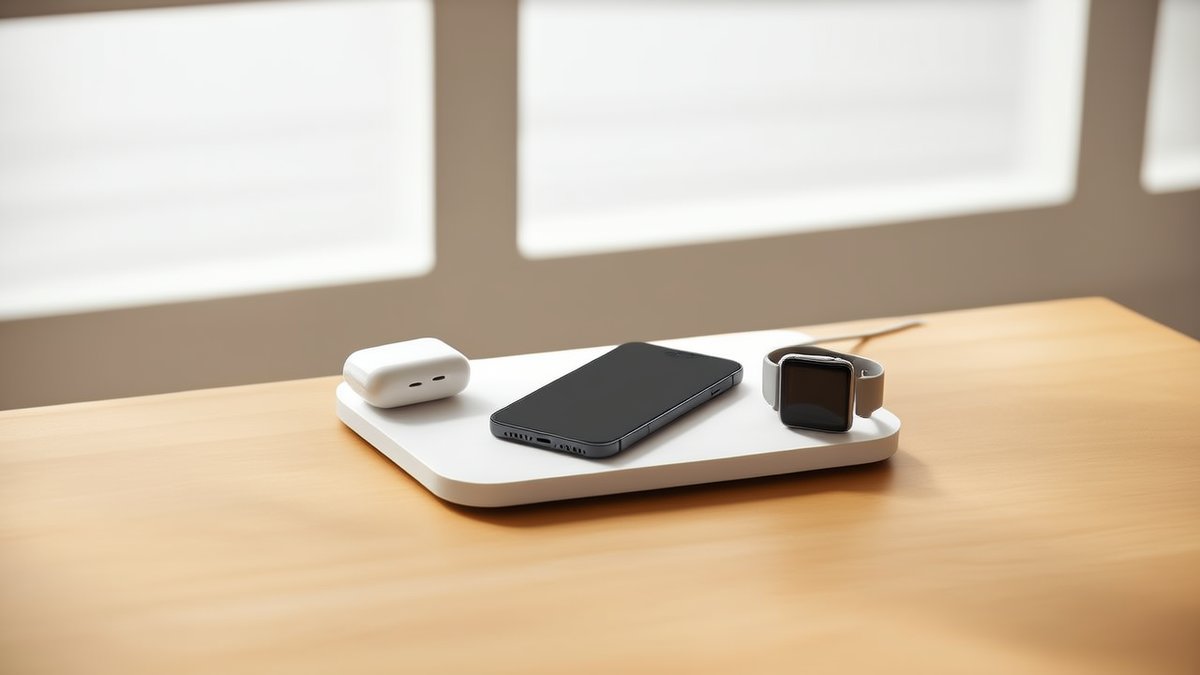
Under the surface a multi-device pad lays out a grid of transmitting coils — three in simpler designs, a denser 3x3 mesh in others. When you set a device down, the controller scans each coil for load changes (usually by reading its Q value) at high frequency, figures out where the receiver sits and which coils are closest, then switches on only the two to four nearest coils. The rest stay dark, which saves power and cuts cross-talk between coils.
The hard part is doing it at the same time. Three gadgets on one mat, and the system ranks them by type and remaining battery: a phone nearly dead gets priority power, a full earbuds case yields its share. Early designs halted every device the moment you lifted one; modern zone control keeps the rest charging.
Efficiency is the other wall. A single coil with random offset often drops to around 60% efficiency; a multi-coil array using dynamic switching keeps losses under 10% and coupling efficiency at 85% to 90%. Higher efficiency means less heat — and Qi2.2 now mandates a surface temperature cap of 40°C, something easier to hold with coils spreading the thermal load.
Why it is tied to Qi2.2
The multi-device station is one of the largest slices of Qi2.2 certifications. In WPC's registry, 3-in-1 and multi-device stations have long sat near 30% of certified products, and by July 2026 global Qi2.2 certifications passed 600 units. Magnetic alignment (MPP) snaps the phone into place; the coil array lets you drop it anywhere — together that is why desk wireless charging moved from novelty to default.
When you shop for one, do not fixate on the headline wattage. Check for zone scheduling and thermal control; if your household mixes many devices and you want true drop-anywhere convenience, a multi-coil array beats a single coil by a wide margin.
© SWPO. All rights reserved.