
You drop the phone on the pad, the light comes on, and you assume it is charging. Point a thermal camera at it, though, and a misaligned phone is quietly heating up the pad and its own back, while the battery fills slowly. The problem is rarely the wattage printed on the box; it is whether the coils actually line up.
Wireless charging moves energy through the magnetic field between two coils, and the better they couple, the less is wasted. Engineers use a coupling coefficient, k, for this: near-perfect alignment sits around 0.7 to 0.8, and a few millimetres off can drop it below 0.6. The power that actually transfers scales roughly with k squared, so a small miss gets amplified. Lab figures make it concrete: end-to-end efficiency is about 85% when aligned, falls to 72% at a 2 mm offset, and drops to 58% at 5 mm, with the lost energy turning into heat that forces both devices to throttle.
How the magnet array snaps the coils back into place
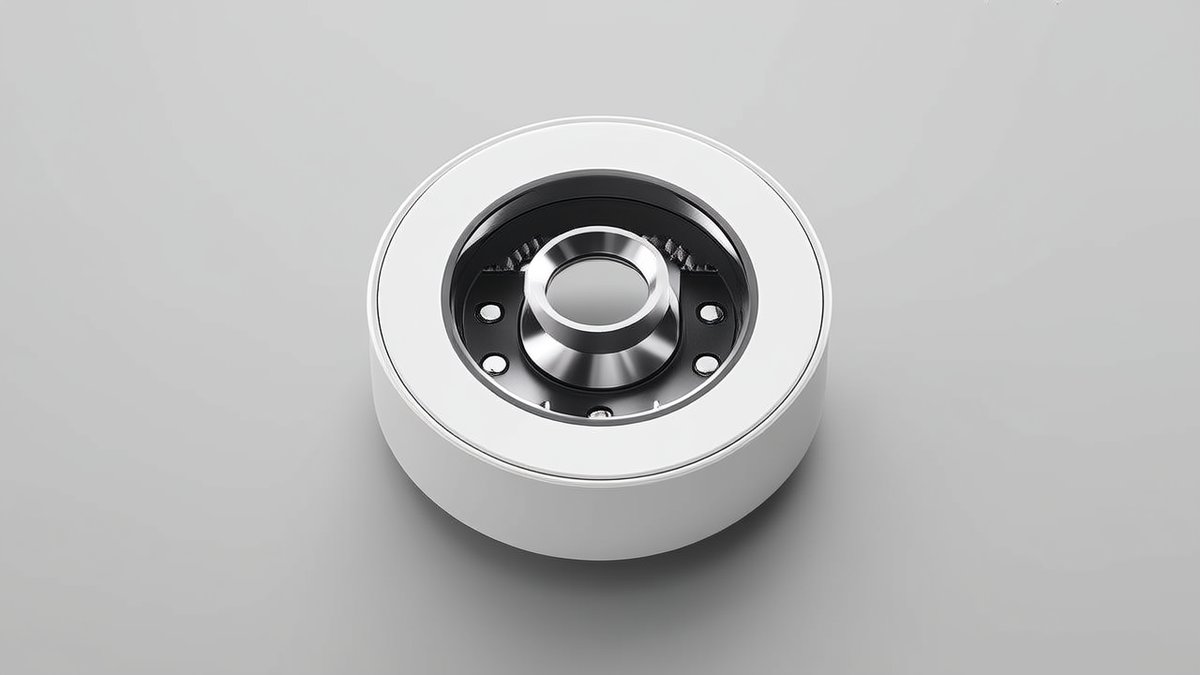
Magnetic alignment exists to fix exactly this. A ring of small neodymium magnets is arranged as a Halbach array, with polarity tuned so the field strengthens toward the phone and cancels on the inward side. That gives a strong hold without interfering with the coil, compass or camera stabilisation. Qi2's Magnetic Power Profile, building on the MagSafe idea, turned this into a common spec: any compliant device and charger snap into the optimal position on contact, no fiddling required.
Why 25W only delivers when magnets and cooling pull together
This is also why 'magnetic' and '25W' keep showing up together. Magnets make sure the energy gets across efficiently, which keeps the remaining heat manageable; a misaligned charge loses efficiency first and hits thermal limits before the rated speed is reached. So when choosing a magnetic wireless charger, the Qi2 / MPP certification matters more than the wattage number, because it means alignment and thermal control have both passed scrutiny. For the people building these products, the magnet array and the cooling have to be tuned together, or the rated power is just a claim.
The takeaway: the magnet is not there for the satisfying snap. It is what lets 25W actually go in, and stay in, without cooking the phone.
© SWPO. All rights reserved.