
You have probably lived this moment: you drop your phone on a wireless pad, it sits a little off-center, and the charge crawls while the pad gets warm to the touch. The culprit is two words — alignment. Wireless charging works through electromagnetic induction between two coils, and they need to line up like two stacked plates, sharing an axis and sitting dead center, for power to move efficiently. Shift the phone and the magnetic coupling weakens, efficiency drops, heat rises, and the charger may stutter on and off near a full battery.
Why conventional coils are so picky
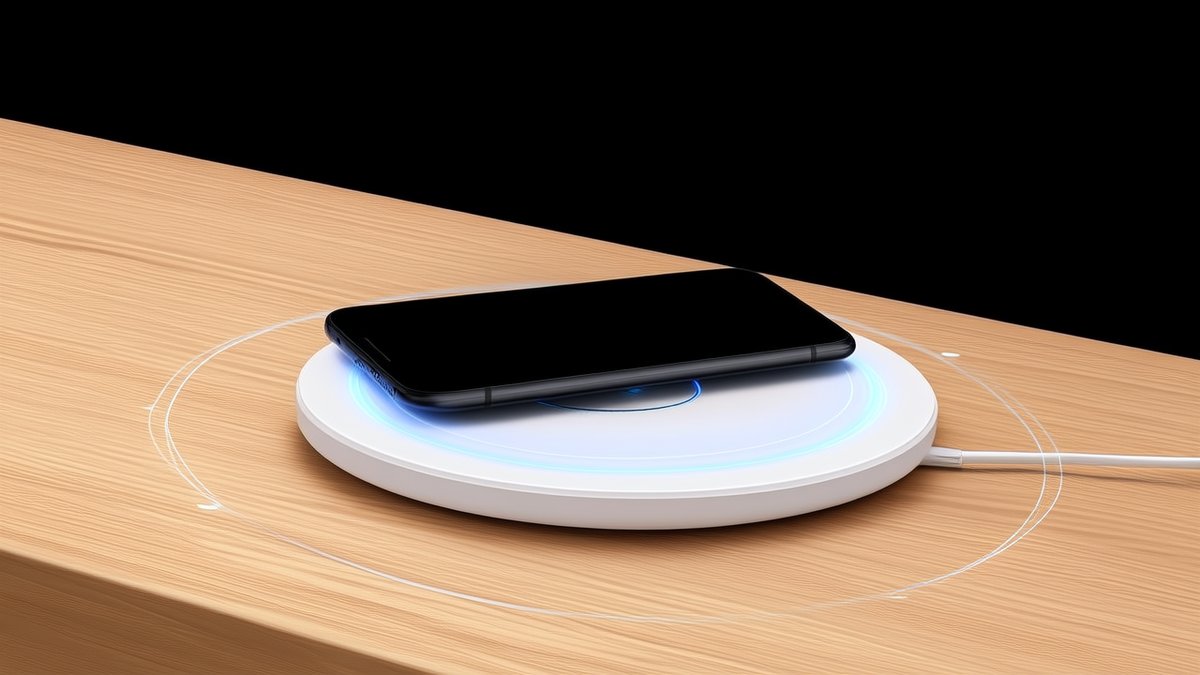
In plain terms, the usable charging zone of a flat coil is a small patch right in the middle. A 2026 paper by Wang Yijie and Mai Jianwei at the Harbin Institute of Technology, published in Communications Engineering (a Nature-portfolio journal), points out that conventional inductive systems are extremely sensitive to coil alignment — even a few millimeters off and efficiency falls sharply. That is why many pads print a ring and tell you to 'center it.' But nobody centers the phone perfectly every time, especially at night when you toss it toward the nightstand blind.
To enlarge that sweet spot, engineers mostly threw hardware at the problem: thicker coils, pricier magnetic materials, multi-coil arrays. Arrays do let you charge from more positions, but they raise cost and control complexity, and different coil geometries — square versus double-D, say — still do not interoperate, so switching devices can break the peace again.
Foldable flux: bending the magnetic field where it needs to go
This paper takes a different route, called foldable magnetic flux transformation. The researchers embedded foldable magnetic pathways inside flexible composite layers and reshape the flux like origami, steering it toward the receiver no matter where the device lands. The structure reconfigures the magnetic circuit on the fly, gathering the field to the receiving coil instead of guarding the center point.
The numbers make the case: across lateral misalignment of several centimeters, power-transfer efficiency stays above 85 percent, whereas a rigid coil array falls off a cliff past a few millimeters. Just as important, it tolerates different coil shapes, nudging the dream of 'one pad for many devices' forward. For consumers it hints at a future where you simply toss the phone onto a mat and it charges; for cars and industrial gear, less precise parking and sensor placement matter even more.
Of course this is still lab work with distance to production: durability of the flexible magnetic material, magnetic decay after thousands of folds, plus heat and cost, all need hardening before it ships. But the direction is clear — the next chapter of wireless charging is not about who stacks the highest wattage, but who makes 'drop it anywhere and it charges' an everyday reality. If you are building or sourcing your own brand, watching magnetic-circuit design and misalignment tolerance will pay off more than staring at the watt number on the box.
© SWPO. All rights reserved.