
Most people assume a wireless charging pad is off when no phone is on it. It does not light up, does not beep, does not get warm. In reality it never stops looking for a phone, and that search costs power. How much power is exactly the number regulators have been tightening for the past two years.
What it does while idle: feel first, then call
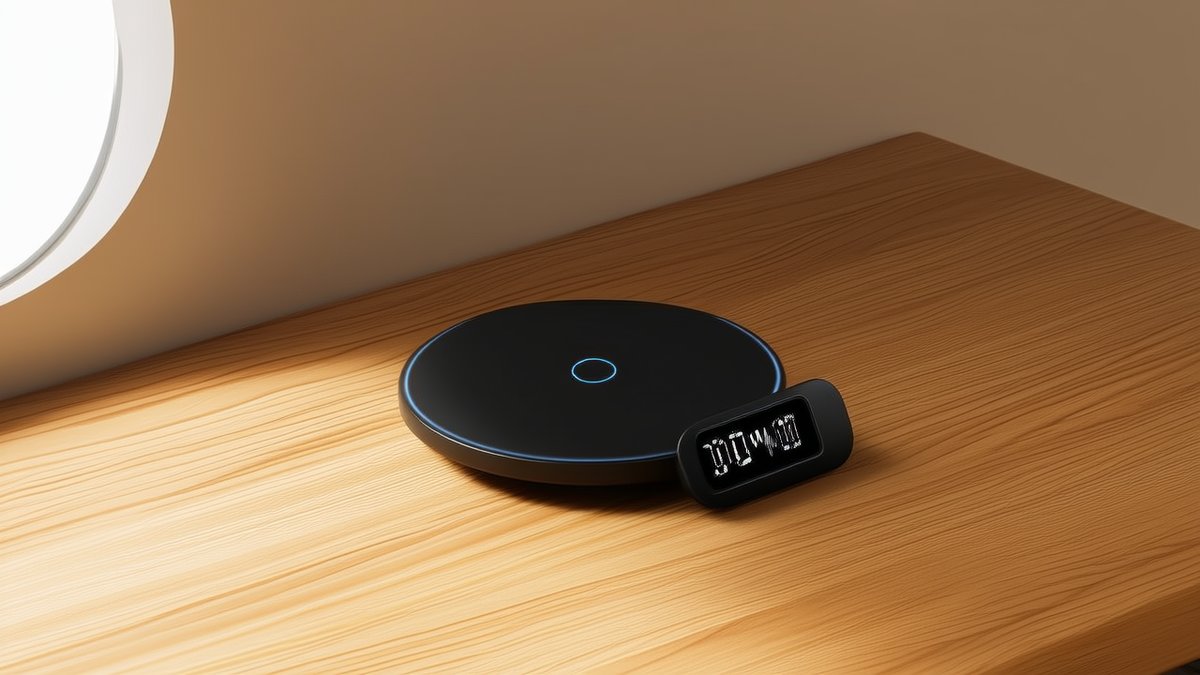
Under the Qi design, a transmitter does not fully power down in standby. It periodically pushes short test pulses into the coil, a step called an analog ping. The principle is simple: with no receiver nearby, the voltage across the primary coil sits noticeably higher, and when a device or a piece of metal comes close, the loading effect pulls that voltage down. A coil reading 60 volts peak to peak might drop to 30. That drop tells the transmitter something may have been placed on top.
Then comes the digital ping, a longer pulse lasting roughly 65 to 70 milliseconds, carrying enough energy to wake the receiver's control electronics. The woken receiver replies with a signal strength packet, and that packet is what separates a compliant Qi device from a stray coin. Only a valid reply moves the system into identification and configuration, and then into actual power transfer. During transfer the receiver sends a control error packet about every 250 milliseconds so the transmitter can adjust output, and the moment the device is removed and communication stops, the transmitter shuts down rather than energising empty air. This is why idle draw is small, and also why it is not zero.
Regulators care about this number: 0.5W standby for wireless chargers
European requirements have been tightening. Under the current external power supply rules, 2019/1782, wireless chargers are capped at 0.5 watts no-load, and wireless chargers with an integrated power module are allowed 0.8 watts. The newer 2025/2052 took effect on 14 December 2025 and becomes fully mandatory on 14 December 2028, extending scope from phone chargers to wireless chargers, charging pads, portable battery chargers and even USB-C cables, while removing the 250 watt ceiling. Under the new rules a single-voltage AC-DC supply below 49 watts must hold no-load draw to 0.075 watts, wireless charging standby stays in the 0.5 watt band, and a mandatory 10 percent load efficiency arrives: 78 percent above 10 watts, 83 percent above 49 watts, with power factor no lower than 0.9 above 25 watts output.
What do those numbers mean in practice? Something simple. A compliant wireless charger wastes a few kilowatt-hours a year at most when idle, which is close to nothing. A cheap uncertified pad that lives plugged in beside the bed with a ring of glowing lights is a different order of magnitude once standby draw and the LEDs are added together. Two buying checks cover it: look for a Qi or Qi2 mark, which means the product passed a test suite that includes energy performance, and look at whether the thing has an always-on light or display.
One-line advice: there is no need to unplug the charger every night, but do not buy a pad that carries no mark and glows all day. The real waste is not the fraction of a watt at idle. It is a product that cannot even get foreign object detection and thermal control right.
© SWPO. All rights reserved.