
If a household has only one wireless charger, it usually ends up on the nightstand. That spot has its own logic. It hosts the longest charging session of the day, and it hosts a user who is lying down with eyes closed, at their most sensitive to light and sound. Picking a bedside pad is a different exercise from picking a desk one.
Sort out light and sound first: anything that glows or hums all night is out
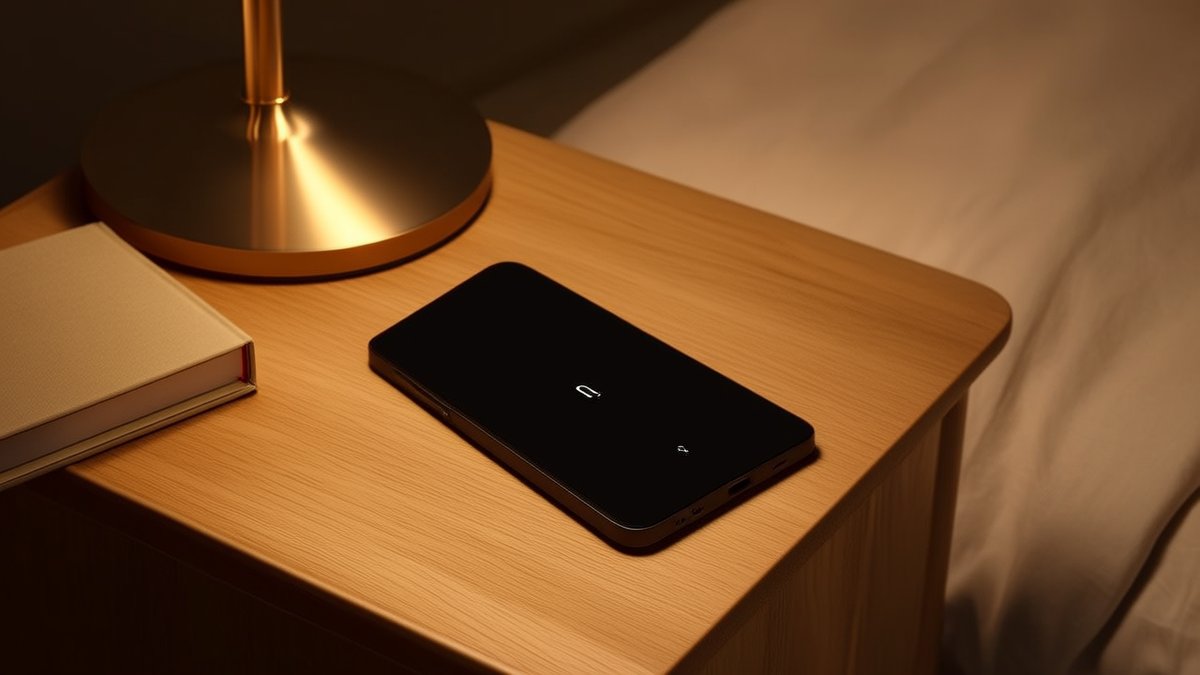
The most overlooked and most disruptive detail is the indicator light. Plenty of pads hold a steady green while charging and add a breathing ring when full, and on a nightstand that glow is loud in a dark room. Treat whether the light can be switched off or dimmed automatically as a hard requirement. Products that warm their light at sunset and fade out when charging finishes are worth more than a few extra watts. Noise comes second: the 25 watt tier has started shipping pads with active cooling, and a small fan at three in the morning is very audible. If the pad goes beside a pillow, prefer a passive design, or accept a slightly lower wattage.
Then heat and stability: the invisible part of comfort
Wireless power is not a constant. It follows temperature. Qi2.2 carries a hard requirement that module surface temperature stay below 40 degrees Celsius at 25 watts rated output, and that line matters more at a bedside. A hot pad heats the phone, and a person lying next to it has little patience for warm hardware. The practical rules: skip very thick silicone cases, keep wallets off the back of the phone, and leave nothing between phone and pad. Stability matters too. A slick case on a light pad slides when you roll over, so a non-slip base or a magnetic hold pays off. Magnets are not only about alignment, they also stop the phone wandering. One more consideration: if earbuds and a watch share the nightstand, a 2-in-1 or 3-in-1 pad solves three devices from one socket.
Finally, safety. Do not leave metal on the pad, and do not tuck the pad under a pillow or sheets, because metal heats up from eddy currents and bedding traps heat. Choose a model with thermal control and foreign object detection carrying a Qi2 or Qi2 25W mark, which is more useful than staring at the wattage number.
One-line advice: a bedside pad is judged on four things. Does it glow all night, does it hum, does it run hot, and does it slide when you touch it. Get those right and 15 watts versus 25 watts becomes the last question, not the first.
© SWPO. All rights reserved.